How to Track Wedding RSVPs Without Losing Your Mind
Published: 1 August 2026
Somewhere between sending the invitations and walking down the aisle, you have to answer one deceptively simple question: how many people are actually coming? Working out how to track wedding RSVPs is what stands between you and a week of frantic phone calls the night before your caterer's deadline. The good news is that this is a solvable problem. It needs a small system rather than more worrying, and the system can be simple.
Why an accurate headcount matters
An RSVP list is not a courtesy. It is the input for almost every practical decision left in your planning, and several come with a date attached.
- The venue needs to know how many tables fit the room, and whether you are near a minimum or a maximum.
- The caterer prices per person and asks for a final number in advance. Your contract names the exact date, often a week or two before the wedding. Read it now.
- Rentals follow the same number: linens, glassware, cutlery, extra seating for the ceremony.
- Place cards and the seating plan need the list to be right down to individual names, not just a total.
Both kinds of error cost you. Guess high and you pay for plates nobody eats. Guess low and someone you love ends up standing at the back of the room.
If the whole idea still feels formal and old-fashioned, our explainer on what RSVP means covers what you are really asking guests to do.
The three common ways to track RSVPs
Nearly every couple uses one of three approaches, or a blend. None is wrong. They just fail in different places.
Calling and messaging everyone
This is the warmest method, and for some guests it is the only one that works. An older relative who does not use the internet will always be a phone call.
The trade-off is that answers arrive as fragments. A voice note here, a message thread there, a "we should be able to make it, I'll confirm" that never gets confirmed. Plus-ones stay vague, and every answer has to pass through your phone before it exists anywhere. Best kept for the people who need a personal touch anyway.
A spreadsheet
A spreadsheet is free, sortable and easy to share with your partner, and you can hand it straight to the caterer at the end.
The catch is that it only collects what you type into it. It is a record, not a collection method. You are still the data entry clerk, typing names on a phone screen at midnight, and one mistyped party size quietly becomes a wrong headcount.
An online RSVP page
Here the invitation carries a link, guests answer on it, and the answers collect themselves in one place. Nobody has to relay anything, and you can check the list at any hour without doing arithmetic.
Two things still matter. Guests should not have to install anything or create an account to answer, or a chunk of your list simply will not. And you need a way to add an answer manually for the aunt who told you in person.
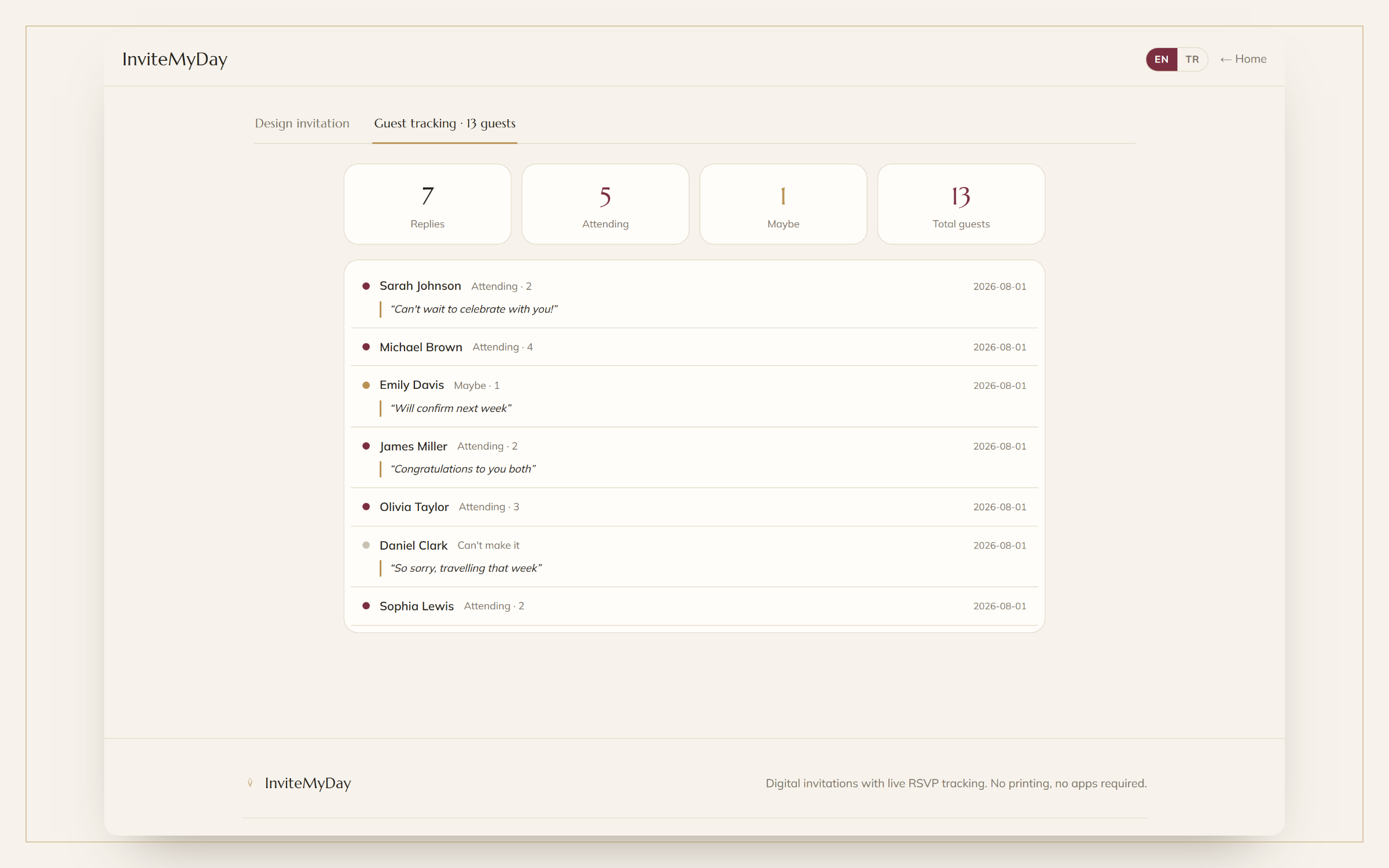
That is what InviteMyDay is built around: the invitation and the live RSVP tracking are the same thing, and guests reply with attending, maybe or can't come along with their party size and a note.
The honest answer is usually a combination. Use an online page for the majority, pick up the phone for the ten or fifteen people who need it, and let one place hold the final truth.
What to record for every guest
Whatever method you use, capture the same fields. Much of the stress of the final fortnight comes from having a total but not the detail behind it.
- Full name, written the way it will appear on a place card.
- Household or party group, so you can see that one invitation covers four people.
- Party size invited and party size confirmed, as two separate numbers. They differ more often than you would expect.
- Status: attending, maybe, not attending, or no reply yet. Keep "no reply" distinct from "not attending", because those need completely different follow-up.
- A free note: dietary needs, a highchair, step-free access, arrival day, a song request.
- Who is chasing them, if you are splitting the list with your partner or your parents.
One rule worth setting early: a maybe is not a yes. Count maybes on their own, and decide in advance the date on which an unconfirmed maybe becomes a no.
Chasing non-responders without being rude
Some people will not reply, and it is almost never about you. Invitations get buried, messages get read at a red light and forgotten, and a few guests are genuinely waiting on a work schedule.
- Assume the message got lost, and write as though it did. "I know how these things disappear, just checking this reached you" gives everyone an exit.
- One person, one message, in the channel they actually use. Group messages to non-repliers read as a public telling-off.
- Give the reason and the date. "We give the caterer final numbers on the 14th" is a fact rather than pressure, and far easier to act on than "let us know soon".
- Make replying take five seconds. Resend the link, or offer to record it for them: "just send back yes or no and I'll add you."
- Split the list. Your partner chases their side, your parents chase their own relatives.
- Three touches, then close the loop. A gentle nudge, a direct ask with the deadline, then a phone call. After the third, mark them as not attending and say so kindly, with an open door if things change.
Never guilt anyone, and never mention money. Your strongest position is that you would love them there and you owe a caterer a number by Thursday.
A realistic timeline, counted back from the wedding
Dates shift depending on your suppliers, but the shape holds.
- Twelve weeks or more out. Finalise the guest list, gather addresses and phone numbers, and decide who is invited to which parts of the day.
- Six to eight weeks out. Send the invitations. If the wording is still unwritten, our invitation wording examples give you a starting point.
- The first week after sending. A good chunk of your list replies immediately. Record every answer as it lands, including the voice notes.
- Four weeks out. First nudge to everyone who has not replied. Friendly, short, no deadline drama yet.
- Three weeks out. Your stated RSVP date passes. Second message, this time naming the caterer's deadline.
- Two weeks out. Phone calls for the last few, and the conversation that turns every maybe into a yes or a no.
- Your caterer's deadline. Submit the number, and ask how late a change can still be made.
- The final week. Seating plan, place cards, table numbers. Route late changes to one person, ideally not you.
- The day before. Hand the venue coordinator the final list with the notes: allergies, access, late arrivals.
Set your RSVP date at least a week before your caterer's deadline. That gap is not padding, it is the week in which you chase people, and you will use all of it.
Getting to a final number you trust
- Count adults and children separately. Caterers usually price them differently, and suppliers will ask.
- Ask about vendor meals. Photographers and bands often eat on site but do not sit at your tables. That number belongs in the catering total, not the seating plan.
- Apply your maybe policy on the date you set, rather than relitigating each one.
- Ask what a late addition costs before you decide whether to build in slack.
- Freeze the number and write it down, with the date and who you told.
- Keep the list live until the day. Illness happens in the last week, and if your record is still the single source of truth, the seating plan takes twenty minutes to redo rather than a whole evening.
Your final number will never perfectly predict who walks through the door, and it does not need to. Aim instead for a list you trust, built early enough that the last fortnight belongs to the wedding rather than to arithmetic.